

Building the App
In this article series, we’re building an app together. The current idea is simple:
find apps that are profitable on WooCommerce but don’t exist on Shopify.
In the previous article, we spent a bunch of money on a lead generation site and advertising campaign. That wasn’t too successful. In this article, we’re actually going to speed-build our app, deliver real value to users, and generate leads.
Getting the Data
To build the app, we need two datasets:
WooCommerce app data
Shopify app data
This data isn’t available via API, so the best solution is to scrape the app pages. Fortunately, this is already a solved problem. Apify can scrape most sites, letting us gather what we need quickly.
I signed up for Apify, paid $40 for a monthly subscription, and immediately cancelled it since I only needed it for a day.
The two scrapers I used:
Shopify apps — https://apify.com/jungle_synthesizer/shopify-app-store-scraper-2
WooCommerce apps — https://apify.com/jupri/woocommerce
With almost no configuration, I was able to start both scrapers. Within about an hour, all the data for the two app stores was ready.
The scraped data included fields like:
Description
Name
Url
Rating
Number of reviews
Free or paid
This was enough for me to compare the apps in WooCommerce to those in Shopify.
Building the Comparison Pipeline
I fired up Cursor, the AI code editor, and asked it to build me a data comparison pipeline.
Here’s what I instructed it to do:
Load
shopify_data.jsonandwoocommerce_data.jsonand understand their structure.Create a script to clean the WooCommerce data:
remove free apps
remove unused fields like images
include only apps with reviews
Create another script to clean both datasets. To make apps comparable, pass their descriptions to ChatGPT and ask it to summarise their features so they can be matched.
Once both datasets are cleaned, create a comparison script that:
outputs WooCommerce apps that don’t exist on Shopify
groups apps that do exist on Shopify, so I can verify the matches
sorts results by number of WooCommerce reviews
Create a Makefile to manage everything.
Use Python, set up a simple project structure, and add one test per transformation.
Cursor built a decent first version. I refined it, added logs, and integrated https://openrouter.ai/ for the embedding step.
Using Embeddings to Compare Apps
The project works by converting app descriptions into “embeddings”—a representation of the semantic meaning of the text. Embeddings are cheap to compute, and OpenRouter makes them easy to generate. More info here: https://openrouter.ai/docs/api-reference/embeddings.
Once the embeddings were ready, I asked Cursor to create a script that compares Shopify and WooCommerce embeddings. It separates out the WooCommerce apps that don’t exist on Shopify.
That was the goal—and we achieved it.
In the end, we had a list of about 120 WooCommerce apps that don’t exist on Shopify.
Turning the Data Into a Website
Now I needed a way to share this with users and generate leads.
Initially, I considered monetising the list. But 120 felt too small, and I’m prioritising audience building. If I expand into other marketplaces (like Notion), then charging might make sense. For now, the list makes a good lead magnet.
To build the website, my preferred workflow is:
Go to Loveable or Vercel V0
Generate a website from a prompt
Connect it to GitHub
Download locally and open in Cursor
Start local development
Deploy to Vercel (free)
Configure DNS on madesolo.com
This is the same approach I used for https://tokencrush.ai/.
After playing around, I found a design I really liked.
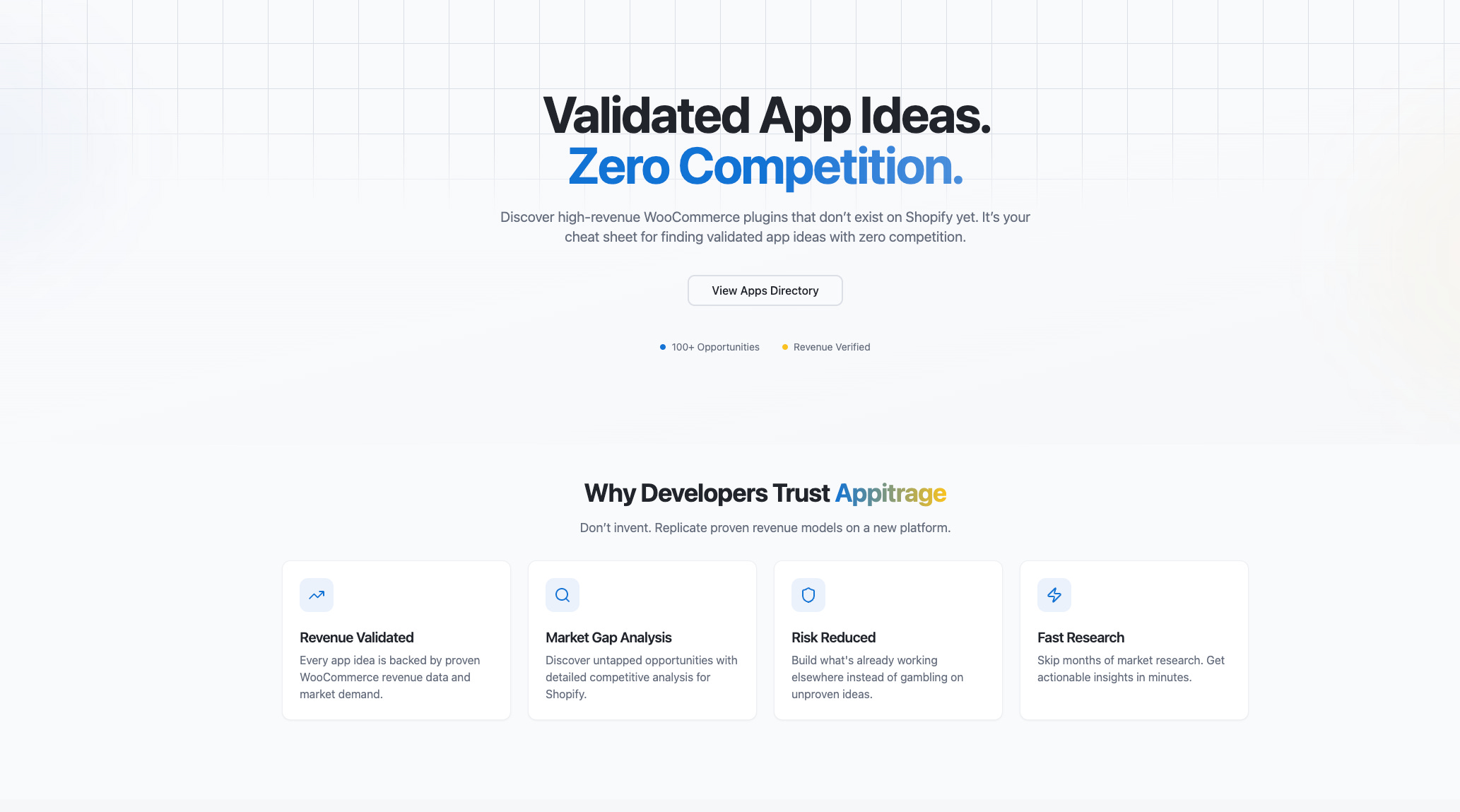
I started with a landing page, then created the directory of WooCommerce apps. Most of them are blurred to give a preview. Cursor made this straightforward.
I used Clerk for user accounts and sign-in. It’s a very smooth authentication tool that I wish I’d discovered earlier. It also collects emails for me and is free up to 5,000 users—much better value than the lead-gen tools I tried.
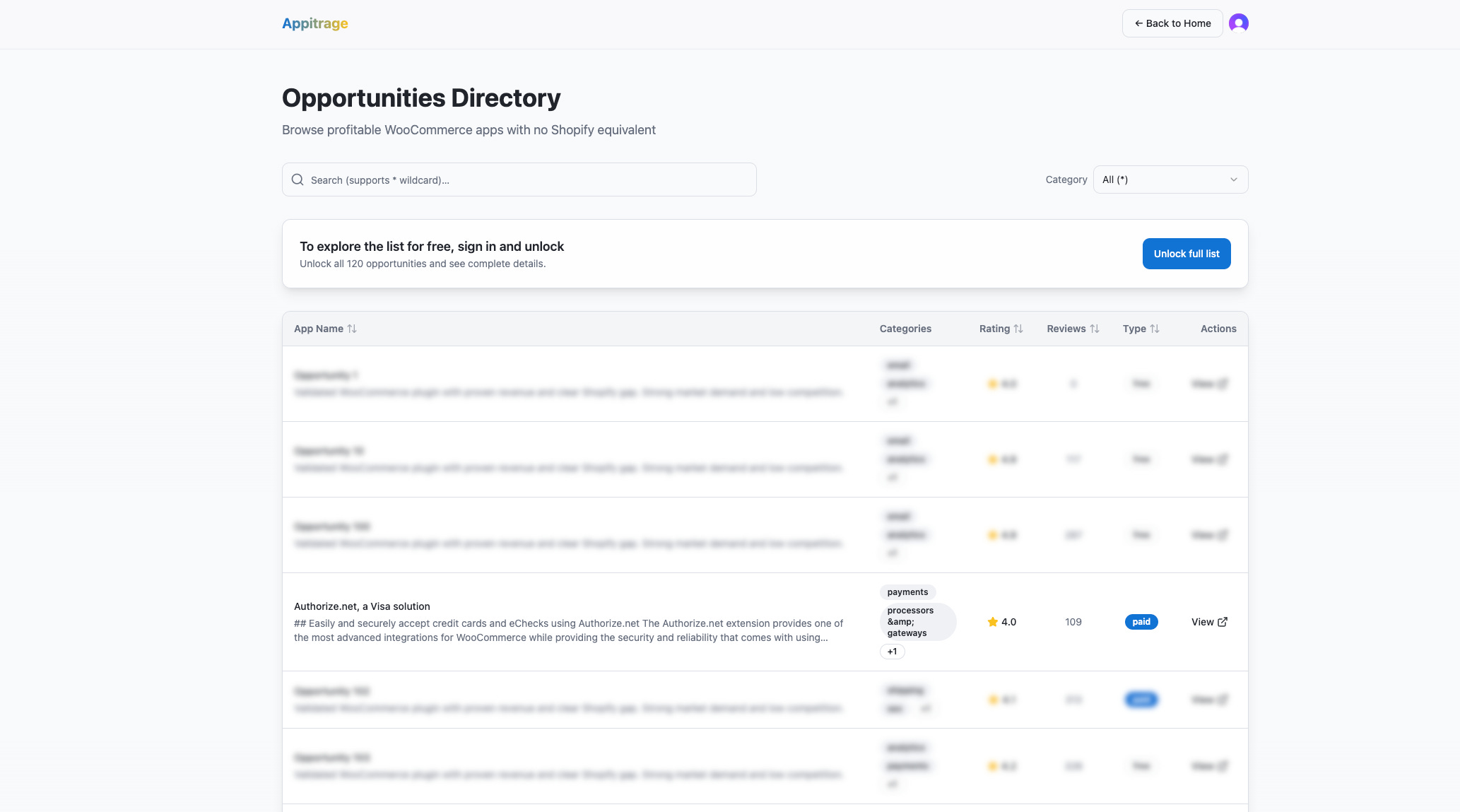
You can likely see it live at: https://appitrage.madesolo.com/
Costs and Time
All of this was very budget-conscious:
~$50 to scrape and compare the data
$20/month for Cursor (which I already pay)
$1/month for the domain (which was already paid)
Everything else: free
Total time: about 12 hours
The project is fully finished.
What This Achieves
This gives us a clean lead magnet—free, useful content in exchange for signups. Anyone who signs up is clearly interested in this area. We can use that group to promote future work. It also helps spread awareness of this blog. And the people who use the app likely fit the profile for madesolo.com.
Next, we’ll share the app with our current leads and watch for traction. If it performs well, we can expand into other marketplaces.
I hope you enjoyed this article in the series. It was a productive one, and I’m delighted at how achievable it is to go from idea to live app in a single day.
Regarding the topic of the article, your rapid prototyping strategy is genuinely insightful. Leveraging Apify for data acquisition and an AI code editor like Cursor for the comparison pipeline demonstrates a verry efficient development workflow. It's a smart approach to market validation.